“While exploring multi-agent systems, I realized that the coordination patterns we use in AI today aren't entirely new. Similar patterns have existed for decades in organizations, governments, biology, and economics. This article summarizes my understanding of different multi-agent architectures and the fascinating connection to the Complexity Theory of Organizations.”
The Different Multi-Agent Architectures
Lately, I've been working on multi-agent architectures, and I came across multiple architectures that are widely used in the industry. At a high level, there are two broad categories of architectures: centralized and decentralized.
In a centralized architecture, there are two common patterns:
- Supervisor Architecture, where every specialized agent reports to a single supervisor.
- Hierarchical Architecture, which consists of multiple levels of supervisors. It follows a manager-CEO structure, where each manager handles a set of workers, and the CEO only needs to coordinate the managers instead of every specialized agent.
The third is the Decentralized (Swarm) Architecture, where every agent can communicate directly with every other agent.
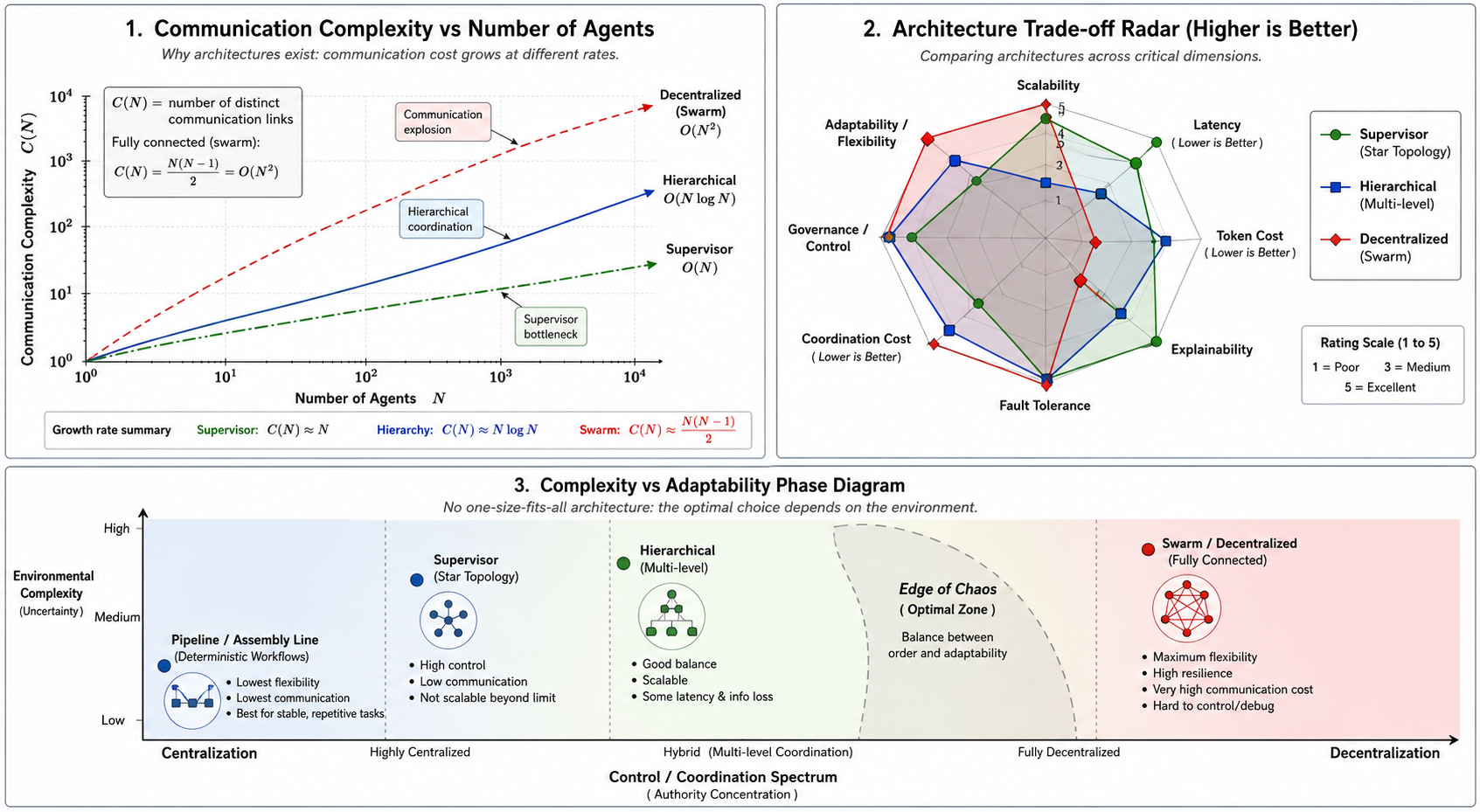
Below is a visual comparison of these architectures, their communication complexity, architectural trade-offs, and where they are best suited.
Centralized Architectures
Supervisor Architecture
The Supervisor Architecture has several advantages: easy tracing, low token cost, and easy governance. However, it also has some disadvantages.
- It creates a single point of failure — if the supervisor makes the wrong decision, the entire system follows that decision.
- It doesn't scale well. For example, if we have hundreds of specialized agents, one supervisor eventually becomes overloaded and cannot efficiently coordinate all of them.
Hierarchical Architecture
The second is the Hierarchical Architecture, which is similar to how organizations are structured. We have a CEO, multiple managers reporting to the CEO, and each manager is responsible for a group of employees.
The biggest advantage of this architecture is excellent task decomposition. Every manager or supervisor only needs to handle its own domain, making the system highly scalable. You can potentially scale it to thousands of specialized agents. However, it comes with several drawbacks.
- High latency, since every request has to travel through multiple levels of supervisors before reaching the final worker and then return through the same hierarchy.
- Context loss, because every supervisor summarizes information before passing it to the next level, which may result in important details being lost.
- Higher token cost because of multiple prompts, multiple memory states, and repeated context passing.
Decentralized (Swarm) Architecture
The Decentralized (Swarm) Architecture allows every agent to communicate directly with every other agent. Its advantages are that it is highly flexible, fault tolerant, has no single point of failure, lets agents naturally adapt to changing situations, and makes collaboration much easier. However, it also has significant disadvantages.
- Communication can quickly explode as the number of agents increases.
- Very high token costs.
- Duplicated reasoning.
- Debugging becomes extremely difficult because there is no central coordinator keeping track of the overall reasoning process.
A Question That Made Me Curious
While exploring these architectures, I realized something interesting. I started looking into other fields such as biology, governments, economics, and corporate organizations. One question kept coming to my mind:
“Why do these coordination patterns keep appearing across completely different domains?”
This led me to the Complexity Theory of Organizations, a concept that I found incredibly fascinating.
Complexity Theory of Organizations
One of the key ideas is that complexity does not grow linearly. As every new decision-maker interacts with others, the number of possible interactions grows rapidly, making coordination itself the bottleneck.
From a systems perspective, different architectures exhibit different communication complexities:
- Supervisor Architecture: O(n) communication complexity, where every worker communicates only with the supervisor.
- Hierarchical Architecture: approximately O(n log n) communication complexity due to structured coordination across multiple layers.
- Decentralized (Swarm) Architecture: O(n²) communication complexity, since every agent can potentially communicate with every other agent.
As shown in Figure 1 (top-left), unrestricted communication quickly becomes prohibitively expensive as the number of agents increases. This explains why large organizations — and increasingly, large multi-agent systems — naturally evolve structured coordination mechanisms instead of allowing unrestricted communication.
Why Organizations Exist
From there, I realized that organizations primarily exist to reduce the cost of coordination. Take a typical company as an example. We have a CEO, managers, and employees. Employees don't directly communicate with the CEO. Instead, they communicate with their managers, and the managers communicate with the CEO.
This structure exists because unrestricted communication becomes too expensive as organizations grow. Interestingly, this is exactly the same problem that modern multi-agent systems try to solve.
The Bigger Insight
This theory explains why these architectures exist, not just how they work. It isn't limited to AI agents. It explains how organizations evolve, how biological systems coordinate, and how large groups of autonomous entities manage to function efficiently as they scale.
The more I explored this topic, the more I realized that multi-agent architectures are essentially computational versions of organizational structures.
Why Hybrid Architectures Win
Finally, one of the most interesting arguments made by Complexity Theory is that the best-performing organizations are usually neither fully centralized nor fully decentralized. That makes a lot of sense because, in production AI systems, we rarely see a pure architecture. Instead, most real-world systems adopt a hybrid architecture, combining centralized governance with decentralized execution depending on the problem being solved.
As illustrated in Figure 1 (bottom panel), there is rarely a universally optimal architecture. The appropriate design depends on the environmental complexity, desired level of coordination, and communication constraints. This is why most production systems adopt hybrid architectures rather than purely centralized or fully decentralized ones.
Final Thoughts
What started as an exploration of multi-agent architectures eventually became a lesson in organizational science. The fascinating part is that these coordination patterns are not unique to AI. They have existed for decades in organizations, governments, biology, and economics.
Perhaps AI isn't inventing new organizational structures — it is rediscovering principles that have governed complex systems all along. I'd love to hear your thoughts on this.
References
Multi-Agent Systems: Wooldridge, M. An Introduction to MultiAgent Systems (2nd Edition); Anthropic, Building Effective Agents; Google Cloud, Choose Design Patterns for Agentic AI Systems; LangGraph Documentation.
Organizational Theory & Complexity: Herbert A. Simon, The Sciences of the Artificial; James G. March & Herbert A. Simon, Organizations; Jay R. Galbraith, Designing Complex Organizations; Ralph D. Stacey, Complexity and Creativity in Organizations; Melanie Mitchell, Complexity: A Guided Tour; John H. Holland, Hidden Order: How Adaptation Builds Complexity.
Network Science: Albert-László Barabási, Network Science (free online book, networksciencebook.com).